
The Future of AI Automation for Businesses in 2026
A practical guide to AI automation, AI agents and workflow automation for businesses that want measurable operational improvements in 2026.
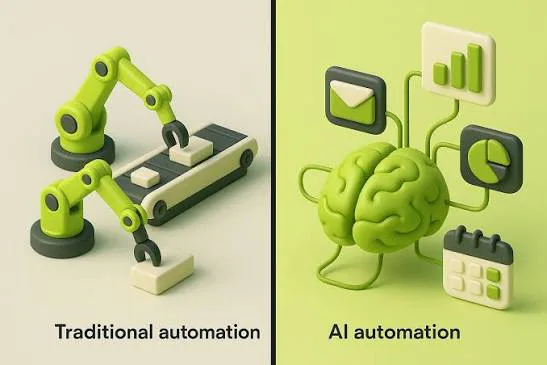
AI automation is moving from isolated experiments to a practical operating model for growing businesses. The important question is no longer whether a team can use an AI tool. It is whether the business can connect trustworthy data, clear decisions and accountable people into an AI-enabled workflow that saves time without creating new risk. For companies in Lucknow, across India and globally, the opportunity is to make routine work faster while keeping the human judgment that customers and teams rely on.
What AI automation means in practice
AI automation combines software workflows with systems that can interpret language, classify information, draft a response or recommend the next action. A traditional automation follows a fixed rule: when a form arrives, create a record. An intelligent automation can also read the enquiry, identify the service requested, check whether essential details are missing and route the lead to the right person. The best use cases are narrow enough to measure and valuable enough to improve every week.
That distinction matters for business automation. Teams do not need an autonomous system making every customer or financial decision. They need dependable assistance around repetitive tasks: lead qualification, document extraction, proposal preparation, meeting summaries, CRM hygiene, support triage and reporting. A good AI workflow automation design makes the hand-off to a person explicit, stores an audit trail and has a safe fallback when the input is uncertain.
Why 2026 is a turning point for AI agents
AI agents are useful when work crosses several tools and needs context, not when they are treated as a novelty chatbot. A sales operations agent, for example, can read an inbound request, enrich it from approved sources, create a CRM task and prepare a concise account brief. A support agent can find relevant help-centre material, draft a suggested answer and escalate a complex issue. In both cases, the agent supports a defined outcome rather than pretending to replace a whole department.
The organisations seeing durable value design agents around a single workflow owner, a small set of permissions and a concrete service-level target. They measure correction rate, resolution time, conversion quality and customer sentiment. This turns AI consulting into an operational discipline: identify the bottleneck, improve the process, deploy the right AI integration and learn from real exceptions. The result is more useful than a dashboard full of impressive but unconnected demonstrations.
Start with workflows, not tools
A productive AI automation roadmap begins with workflow mapping. Follow a high-volume process from trigger to completion and mark the hand-offs, delays, duplicate entry and decisions that rely on scattered information. This often reveals that the first gain comes from clean inputs, a shared CRM definition or a clearer approval rule. AI can then be placed where interpretation is genuinely needed, instead of being asked to compensate for an unclear process.
Choose one workflow with a visible baseline. Lead response time, proposal turnaround, first-contact resolution or monthly reporting effort are all suitable measures. Set a guardrail before launch: for example, an AI chatbot may draft answers but cannot change an account, or an automation may create a CRM record but cannot send a contract. This approach protects customer trust and gives leaders evidence for the next investment.
High-value use cases for growing businesses
Customer-facing workflows are often a strong starting point. WhatsApp automation can acknowledge an enquiry instantly, collect the details needed for a consultation and assign the request to the correct team. AI chatbots can answer common questions from an approved knowledge base, while a human takes over when the request involves pricing, legal terms or an unusual situation. The aim is faster, more consistent customer engagement rather than a dead-end automated conversation.
Internal workflows can be equally valuable. CRM automation can standardise new records, flag stale opportunities and create follow-up tasks. Document intelligence can extract structured fields from invoices, briefs or forms for review. Reporting automation can consolidate data from marketing, sales and operations into a weekly narrative. These business automation solutions remove copy-and-paste work so specialists can spend time on decisions, relationships and improvement.
Data, security and governance are product requirements
An AI system is only as reliable as the context it receives. Before connecting a model to business information, define which data is current, who owns it and what should never be shared. Use role-based access, approved integrations, minimal data retention and clear consent practices. For sensitive workflows, keep a person in the approval loop and retain enough context to explain why a recommendation was made. These controls are not bureaucracy; they are what make an AI solution safe to scale.
Governance also includes a way to handle mistakes. Give staff a simple route to correct an answer, mark an unsafe output or escalate a failed task. Review those signals regularly with the workflow owner. Over time, this creates a quality loop: better source material, clearer prompts, better routing and fewer exceptions. Businesses that build this loop gain an operational asset rather than a short-lived AI pilot.
How to evaluate an AI automation partner
Look for a workflow automation agency that asks about outcomes before recommending a platform. The right partner should be able to explain the trigger, data flow, human checkpoints, monitoring and ownership in plain language. They should be comfortable integrating OpenAI, CRM platforms, messaging tools and custom software where appropriate, but not force every process into the same stack. A proof of value should include a measurable baseline and a plan for support after launch.
Technical capability is important, but adoption is just as important. The people who use the workflow need a simple interface, a clear explanation of when to trust it and a way to take control. Training, documentation and named owners turn an automation from an experiment into a reliable business process. This is the difference between buying an AI feature and building a capability.
A practical 90-day implementation path
In the first 30 days, identify a priority workflow, map the current process and agree on success metrics. In the next 30, build a limited implementation with real data, permissions and human review. Test it against typical and difficult cases before it reaches customers. In the final 30 days, monitor the live workflow, resolve exceptions and document the operating process. This phased approach keeps digital transformation grounded in measurable work rather than broad promises.
Once the first workflow is stable, reuse the lessons. Common naming rules, integration patterns, prompt review and reporting standards make subsequent AI integration services faster and safer. Over time, isolated improvements can become a connected automation layer across marketing, sales, delivery and customer support. The future of AI automation is not a single assistant; it is a well-governed set of systems that gives people more time to do high-value work.
Frequently asked questions
- What is the best first AI automation project?
- Choose a repetitive, high-volume workflow with a measurable delay or error rate, such as lead routing, CRM updates, support triage or document processing. Keep the first release narrow and retain human approval for consequential decisions.
- Can AI agents replace employees?
- AI agents are most effective as workflow assistants. They can handle structured, repeatable steps and surface context, while people remain responsible for judgment, relationships, exceptions and accountability.
- How does AI automation work with a CRM?
- A CRM integration can capture enquiry data, enrich records, classify intent, assign owners and prompt follow-up. Good implementations keep data definitions consistent and let a human review uncertain records.
- Is WhatsApp automation suitable for customer service?
- Yes, when it handles clear tasks such as acknowledgement, qualification and frequently asked questions, with a visible route to a person for complex or sensitive conversations.
- How should a business measure AI automation ROI?
- Track a specific baseline such as response time, hours spent, conversion quality, error rate or resolution time. Compare the result after a monitored release and include the ongoing cost of ownership.
The businesses that benefit most from AI automation will be the ones that pair ambition with operational care. Start with a real workflow, protect customers and employees with clear guardrails, and improve from measurable feedback. That is how AI agents, CRM automation and intelligent workflows become dependable engines for growth rather than another disconnected tool.
Ready to improve a real workflow?
Talk with our team about a focused, measurable project for your website, app, AI workflow or growth system.